Learning Hub
 Sign up to our newsletter

21 April 2026
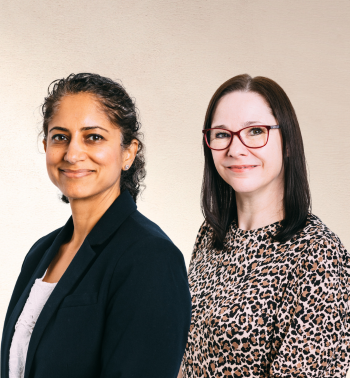
We hear from Dr Rachna Chowla and Wenda Aitchison about the aims and impact of the series - which connects expertise across SEL from primary care, community care, and within King’s Health Partners.
Please could you introduce your roles
Rachna Chowla
My name is Dr Rachna Chowla. I'm a GP in Southwark and Joint Director of Clinical Strategy with Dr Irem Patel at King's Health Partners (KHP).
Wenda Aitchison
Hi, I'm Wenda. I work in the communications team at KHP and I do the project management for the primary care webinars. I work alongside Jen Burt behind the scenes to ensure the events run smoothly for speakers and attendees.
Last year marked five years of the Primary Care webinar series – please could tell us what the events aim to do?
Rachna
We started the webinars in the middle of the COVID-19 pandemic when it was becoming clear that we needed to have a two-way dialogue between primary care and secondary care.
Initially we thought we would start a webinar series to share important insights. For example, when we found out that people of certain ethnicities were at higher risk of COVID-19. At that time, we didn't know why, but the research came from King’s College Hospital NHS Foundation Trust (NHS FT) and it was important to get that disseminated out to primary care.
After the pandemic it developed into a platform where we wanted to develop the parity between secondary care and primary care. We wanted webinars where a range of voices could be represented and which had a strong health and equity angle.
Our aim is to shed light on areas that wouldn't normally be covered in typical primary care update courses, but are still important, and where we as KHP can bring along experts to share and explore important issues.
Wenda
For continuity we've always kept them on the same day and time - Wednesday lunchtime – a time we hope allows as many to join as possible. And we record them, and add, along with the slides, to the KHP Learning Hub, everyone registered gets the link once it's uploaded and can return to it in their own time.
What’s been the impact of the series?
Wenda
We have had 46 webinars since the first was held on 22 July 2020. Over those webinars we’ve had 5,028 registered and 2,020 attendees. As we said, we know that people may not attend on the day but they do go back and watch the recordings on the KHP Learning Hub. We've had participants not just from London, but outside of London, nationally and even internationally.
One thing that stands out for me is the passion of the different people that come to present. The webinars are their platform and they have an opportunity to follow up with an email to attendees afterwards. This could be links to further resources, it could be research opportunities, or further events.
Rachna
Alongside the figures that Wenda mentioned, which are really impressive, we always ask attendees “what's the one thing that you've learned?” and what they have taken back from that webinar to impact on their clinical practice. As a practising GP, I'm still picking up things myself. So there's real benefit in the feedback that we get and how that supports people in their clinical practice or indeed just raises awareness around something that might be on the horizon.
We've had webinars where they have been around issues that are really important to our boroughs in south east London. We had one on urology called ‘How Red is Red’ because bladder cancer diagnosis seems to happen much later in our local boroughs than it does elsewhere.
What’s been your most memorable moment from the series?
Wenda
We had a presenter who joined us live from a barber shop – cutting someone’s hair as he was speaking to us about prostate cancer awareness during a webinar on men’s health. A fantastic example of outreach in the community that we were able to showcase live.
Rachna
Every webinar has something, it's got a gem in there, every single one. We had one on paediatric neurology and how in primary care we can pick certain things up at the six week check. It really highlighted that it isn't a tick box exercise to fill in the red book and make sure the baby is ready for immunisations. There are subtle things that we can pick up that if we see them and the baby's put on the right pathway can totally change the trajectory of that baby and that child's life.
What's next for the primary care webinar series?
Rachna
We have a very large list of themes that our audience would like us to bring. So we try and filter those through the lens of KHP's priorities - in digital health, personalised care, and population health projects such as cardiometabolic health and serious mental illness.
We have an interesting one coming up next on young women and liver disease related to alcohol and obesity. You know, that's the sort of topic that would just never come up on its own in a primary care course or it wouldn't be there so specifically in a guideline. So that's the power of these webinars.
How else is KHP creating opportunities and building capacity in primary care?
Rachna
Yes, there are a few, maybe a couple of ones that are in parallel.
We support the primary care paediatric courses run by one of our wonderful pediatricians, Diana Stan at King’s College Hospital NHS FT, and we’ve run the maternal medicine course for primary care for three years. Again, this is such an important topic that makes a huge difference to the outcomes of babies and women, but one that is too specialist to find in a primary care update course. Yet here at King’s Health Partners we are part of the South East London Maternal Medicine Network and we’re able to make that connection across from them back into primary care. We've had fantastic feedback on each maternal medicine course and they’re all available to watch on the KHP Learning Hub.
We're in the early stages of supporting researchers from within the partnership to engage with primary care on research related collaborations. At the moment, that happens a little bit ad hoc, just through the people we know and them knowing us. But it would be interesting to see how that grows and how we make maybe a platform or make something a bit more systematic around that.
We've also been piloting a GP trainee KHP matching scheme with Dr Eugenia Lee, a GP VTS training lead in SEL and Dr Claire Mallison, Head of KHP Education. GP trainees have half a day a week to do with as they wish during their training, whether it's revising, sitting in a clinic or connecting with opportunities at the university. We’ve asked them what they want from this time. We then look at what connections we can make for them that best matches their training goals.
Find out more about the KHP Primary Care programme.
The next KHP Primary Care Webinar on ‘Young women - liver disease, obesity, alcohol, and fertility issues’ is on Wednesday 20 May 2026 from 1:00pm to 2:00pm. Please click here to find out more and sign up.