Learning Hub
 Sign up to our newsletter
13 February 2026
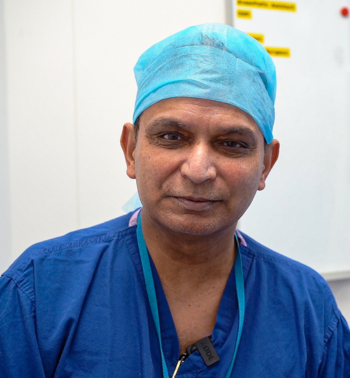
Globally renowned surgical pioneer Prof Prokar Dasgupta is confident about the future of surgery as he prepares for retirement.
The KHP Professor of Surgery, who was awarded an OBE in 2023, believes the profession’s adoption of robotics, AI, and 3D printing will see treatments become more personalised and less invasive.
Speaking to KHP News, Prof Dasgupta also reflected on how surgery has changed over his 30-year career, his proudest achievements, and offered his top tips for young surgeons starting out.
Why did you want to be a surgeon?
I was inspired by my granddad, who was a doctor and very good with his hands. Early on I realised that a craft specialty like surgery would be the one for me. Professionally I was inspired by Prof Chaudhuri who was my surgical boss in Calcutta – now called Kolkata – and Dr Basu, who brought the first stone breaking machine, or lithotripter, to Kolkata.
Watching these fantastic surgeons, I thought why not become a surgeon?
It was a bit of an accident because at the same time I was getting interested in the sciences, so I could have easily become an immunologist. But hey, now I have the best of both worlds – surgery and science.
How has surgery changed since you started out?
When I started it was all open surgery. Early on in my field came endoscopic surgery, which means doing things with a telescope. For example, I initially learned to take the prostate out with a cut in the lower part of the tummy - that’s how it was done.
For kidneys it was a big slash, nearly a foot-long, in your side. But keyhole surgery came about and all that changed. Initially it was laparoscopic surgery, and now we have robotic surgery.
So I think surgery has seen major changes in the last 30 years.
And, of course, one of my heroes, John Wickham, was instrumental in bringing about this change from open surgery to minimally invasive surgery.
How do you see surgery advancing in the next 50 years?
There’s this common misconception that in the future surgery won’t exist, and everything will be treated with immunotherapy, chemotherapy or radiation.
Nothing could be further from the truth.
In particular, if you look at the history of the treatment of solid tumours, surgery still cures nearly half of these patients 100 years on. Therefore, I don't think surgery is going anywhere, but it is going to be more refined.
For example, today we plan procedures by taking images of the patient before an operation and using artificial intelligence to 3D print. Often I receive a 3D print of an individual’s prostate on the morning of their surgery.
So just like we have personalised chemotherapy, I think surgery is becoming more personalised. We are already using digital twins.
We are going to see more precision, less invasion, better cancer and functional outcomes.
There's a misconception that perhaps we are ready for complete automation in surgery. I don't think this is going to happen in the near future.
Although in the lab we can train a machine to do a simple operation - for example, take out someone's gallbladder completely autonomously. If you ask patients - as I did at the Royal Academy of Engineering - and the public what they want, they say not yet. Two words. Not yet.
The public are willing to be part of trials but I don't think they are comfortable yet - even with 100% accuracy - to have the surgeon completely dissociated from the operation. They want a human in the loop.
I think the one thing that will remain constant, not just for 50 years but for 100 years, is the surgeon-patient relationship. The patient looking into a surgeon’s eyes and thinking - ‘I trust you to look after me’.
I don't think that's going to change, however much technology transforms the way we perform surgery.
What are you most proud of in your career?
A number of things, but I think three stand out. Firstly, changing the course of overactive bladder management. When I was training, patients would take a tablet to calm the bladder down, and if that didn’t work you would do what was called a “clam operation”. You’d make a big cut in their belly, open up the bladder like a clam and put a piece of bowel on top of it. It was a complicated procedure and didn't cure everybody.
Overactive bladders affect nearly 250 million people in the world, so it is a major problem.
Our team found nerve fibres called C-fibres, which had been described in cats, also in humans more than 30 years ago. And then we realised that they were highly sensitive to botulinum toxin, or Botox that is applied to our wrinkles.
You put a little telescope in the bladder, and with an ultrafine needle through the telescope inject small amounts of Botox into the bladder wall. This has really changed the management of the condition, and it has now been approved by all the guidelines.
I think over my 30-year career it's probably the thing that I'm most proud of.
It’s called the Dasgupta technique?
I feel very uncomfortable about it because I think it was a team who changed the course of that disease. It's named after me but I wasn't the person responsible for naming it.
The second thing I’m most proud of is changing the course of prostate and bladder cancer with robotic surgery.
Twenty-five years ago they were open operations. We’ve gone from only 1% of radical prostatectomy - removing the prostate completely - being carried out by robotic surgery, to 95% in the UK over the last 20 years.
In bladder cancer about seven in 10 patients who need their bladder removed have robotic surgery. They have quicker recovery, less pain, a shorter stay in hospital, and better outcomes. Not necessarily for the cancer, where the outcomes are equivalent, but in general, and it’s cost effective.
Changing the course of these two diseases with robotic surgery is again something I'm proud of.
And thirdly, making sure that patient safety remains at the heart of it all. We did this with the SIMULATE trial across 15 centres worldwide. We compared young surgeons operating on patients who had had no simulation training, versus those who had.
No surprise, patients in the simulation arm did better - they had fewer complications and the surgeons were more proficient.
This was a massive trial involving more than a thousand patients with contributions from so many colleagues. I am very proud of these three things.
What advice would you give to young surgeons?
As you know I’m not one for giving advice, in fact, I don’t tell anyone what to do. But I've been asked this many times and perhaps three things come to mind.
First, never be afraid to dream big. What's the worst that will happen? You're going to wake up and the dream will not have come true.
Second, do your best without worrying about the outcomes.
And third, always remember you are part of a team and be happy when others within the team do well. Last year at King’s College London eight surgeons were promoted - a record. This brings a whole lot of happiness to me.
These are my three top tips for younger surgeons just starting out.
What are you looking forward to doing in your retirement?
Very simple - how about doing nothing? Perhaps being seen more courtside during tennis tournaments, which is a passion of mine.
But essentially chilling and doing nothing.
___
Prof Prokar Dasgupta OBE is Chair in Robotic Surgery and Urological Innovation at King’s College London, and an honorary consultant urological surgeon at Guy’s and St Thomas’ NHS Foundation Trust.
In 2023 he was awarded an OBE for services to surgery and science. In the same year he received the John Wickham Lifetime Achievement Award for his contributions to robotic surgery. In 2025 he was elected as an Honorary Fellow to the Royal Academy of Engineering.
__
Find out more about King’s Health Partners Academic Surgery and sign up for the next Academic Surgery Grand Rounds.