Learning Hub
 Sign up to our newsletter

7 May 2026
Ask most researchers whether patients should be involved in shaping their work and the answer is almost universally yes.
Ask patients how involved they feel, and the answer is often quite different. They describe feeling like "just another data point." They report being recruited without context, receiving no updates after participating, and finding that the research questions being asked bore little resemblance to the questions they actually wanted answered.
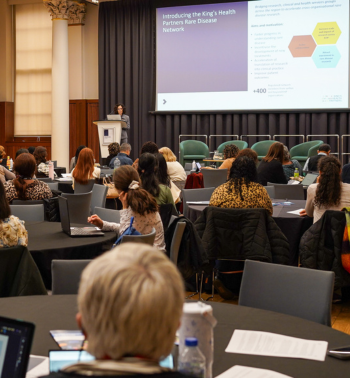
This gap between the intention to involve patients, and the reality of what involvement looks like in practice, was at the heart of a recent event hosted by the KHP Rare Disease Network, titled Demystifying the Connection Between Patients and Researchers.
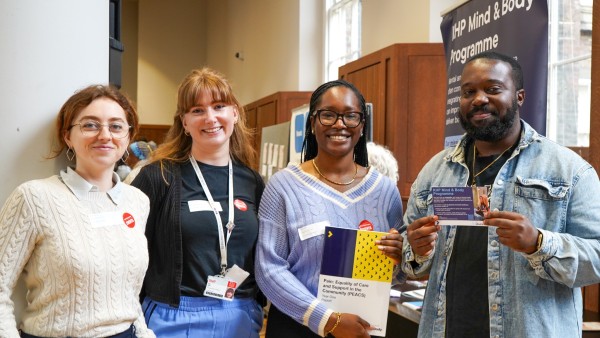
The afternoon brought together clinicians, researchers, academics, patients, advocates, and industry to examine why meaningful patient and public involvement and engagement (PPIE) remains inconsistent across rare disease research, and how this could be changed. Three themes emerged.
The challenge is structural, not motivational
One of the clearest messages of the day came from Dani Bancroft, Senior Policy and Research Officer at Genetic Alliance UK, highlighting research developed with academics and multiple stakeholder groups to identify why effective PPIE so often fails to take root.
Her diagnosis was structural. PPIE tends to depend on the commitment of individual researchers rather than being embedded in the institutions around them. Researchers are rarely rewarded for good patient involvement through career progression. Early-career staff lack the training, institutional backing, and funding to deliver it confidently. Short-term research funding creates what she described as "hidden labour" for existing PPIE staff, and staff turnover erodes the continuity of relationships with patient contributors when projects end.
Her recommendations called for systemic change, including:
- dedicated, permanent PPIE roles within research organisations,
- funding budgeted for patient involvement from the grant application stage rather than added on later;
- PPIE training integrated into academic career pathways and appraisal frameworks; and
- reimbursement processes simple and swift enough to compensate patient contributors fairly.
The core argument was that when PPIE is built into the architecture of research, it stops being optional and becomes the standard.
Meaningful involvement changes what gets researched, not just how
A second theme that ran across multiple sessions was the difference between involving patients in how research is conducted and involving them in deciding what gets researched in the first place.
An example of best practice was shared - a James Lind Alliance Priority Setting Partnership in sickle cell disease and genomics in which patients, carers, and healthcare professionals worked together through a structured, iterative process to agree the ten research questions that the community most wanted answered. Starting with around 50 questions gathered from surveys and workshops, the process narrowed - through two rounds of community voting and a final consensus workshop - to a ranked list that genuinely reflected what people living with the condition wanted to know.
Natasha Gordon-Douglas, Lead Mentor at the Sickle Cell Society, highlighted the need to shift from participation - where patients are recruited into research designed around someone else's questions - to genuine partnership, where patients help shape the questions themselves. That shift, she argued, requires early involvement, shared decision-making, fair compensation, and long-term relationship building rather than a single consultation at the end of a project.
Inclusion is a scientific issue, not just an ethical one
The events panel discussed: who is actually represented in rare disease research, and what happens to the quality and relevance of that research when whole communities are missing from it?
Some genomic databases are 97% European in ancestry, despite white individuals representing approximately 15 to 18% of the global population. Over 90% of drugs currently in development are designed for that same demographic.
Speakers underlined the importance of creating environments where everyone feels genuinely welcome to engage, noting that disadvantaged patients often face compounding obstacles. It was noted that there are particular challenges facing patients with disabilities who may not be able to express their needs or advocate for themselves, and that many communities have well-founded reasons to be cautious about the institutions asking for their involvement.
The solution is not better communications or more targeted recruitment campaigns, but building genuine trust over time. This can be achieved by working with communities before a project begins, ensuring the people leading engagement have authentic relationships with those communities, and demonstrating concretely that involvement makes a difference to what gets studied and how.
There is also a geographic dimension. Dr Elizabeth Forsythe, Consultant Clinical Geneticist at Guy's and St Thomas' NHS Foundation Trust, noted that specialist genetics services are concentrated in major cities, creating real barriers for patients in rural areas or those with limited resources. Caroline Olshewsky, CEO of Lupus UK, was direct: "You need to go to where the people are”.
Where this leads
At the close of the event, Dr Cristina Dias, Chair of the KHP Rare Disease Network, drew together the themes of the afternoon. Two phrases in particular captured the spirit of the day. "The messenger is the message" is a reminder that who leads engagement matters as much as how it is conducted. And "the illusion of inclusion" is a challenge to move beyond the appearance of patient involvement towards the substance of it.
Meaningful PPIE in rare disease research takes time, resources, and institutional commitment. Research which genuinely reflects the priorities and experiences of the people it is designed to help produces better outcomes. In rare disease, where the stakes are high and patient populations are small, that matters enormously.
Find out more about the work of the KHP Rare Disease Network.
Acknowledgements
We would like to thank all those who contributed to making the KHP Rare Disease Network PPIE Event 2026 a success.
Our gratitude goes to our speakers and panellists – Natasha Gordon-Douglas (Sickle Cell Society), Dani Bancroft (Genetic Alliance UK), Dr Rutendo Muzambi (Imperial College London), Dr Sondra Butterworth (RareQoL), Sasha Henriques (Genomics England), Jayne Hughes (Amy and Friends), Dr Hanif Ismail (Leeds Teaching Hospital NHS FT), Dr Deborah Clarke (Alexion), Dr Elizabeth Forsythe (Guy’s and St Thomas’ NHS FT), Dr Veysel Kocaman (John Snow Labs), and Caroline Olshewsky (Lupus UK). Our thanks also go to our poster presenters for showcasing their work, and to our organising committee for their dedication in bringing the event together.
We are also grateful to Chiesi, Vertex, Guy's & St Thomas' Charity, Medics for Rare Disease, and Sickle Cell Society for their generous support in making the event possible.