Learning Hub
 Sign up to our newsletter

24 July 2026
Artificial intelligence (AI) has the potential to transform healthcare and health research, creating new opportunities for clinical academics to accelerate discovery and enhance patient care. How can university healthcare partnerships like King’s Health Partners (KHP) harness this potential and develop an AI-literate NHS workforce?
KHP recently collaborated with the Policy Institute at King’s College London to host an event titled NHS 10 Year Plan: What is needed to deliver a sustainable workforce? The meeting brought together leaders in healthcare to discuss the challenges for building the workforce of the future, which includes moving in step with, and leveraging, technological advances.
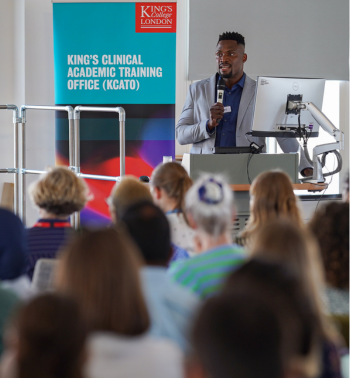
This theme was also explored at this summer’s King’s Clinical Academic Research Symposium, organised by King’s Clinical Academic Training Office (KCATO), which focused on AI and data science in healthcare and clinical research.
Here, we summarise four solutions from these two timely events to suggest ways of improving the AI and digital skills of the clinical workforce:
Provide digital health training
Access to high-quality training is essential. At KHP, the Digital Health Academy offers a range of education and training opportunities designed to support healthcare professionals in developing digital and AI-related skills. Programmes range from introductory courses to more advanced learning opportunities focused on digital transformation and innovation.
Signpost to opportunities across the partnership
University healthcare partnerships offer unique opportunities for collaboration. Encouraging staff to meet clinicians and researchers outside of their area of expertise can promote interdisciplinary working. For example, academics working in engineering or computer science might connect with healthcare professionals to address a clinical problem.
Partnership working also offers more professional development opportunities. For example, clinical academics working at any KHP organisation can access support from KCATO, and those affiliated with King's College London can access a wide variety of professional development opportunities through initiatives such as the Centre for Research Staff Development (CRSD).
Offer tailored fellowships and support the emergence of new career paths
AI fellowships and the emergence of new, AI-focused clinical jobs could be crucial for upskilling the workforce. A good example of this is the NHS Fellowship in Clinical AI, a 12-month part-time programme designed to help clinicians realise the benefits of AI in healthcare while continuing their clinical practice. Dr Alexander Deng, Director of the fellowship scheme, spoke at the recent workforce event about the possibility of ultimately creating new professional bodies for clinicians working with AI.
Support and encourage membership of professional networks
Dr Deng also spoke about the importance of making sure that knowledge from UK AI centres of excellence reaches the wider clinical community. Indeed, it is important to look beyond the immediate environment and identify national and international networks that might be able to support and connect staff.
For example, the AI Nurses Network is a dedicated clinical research network that supports and advances the role of nursing professionals in AI development and implementation. Led by Global Director Dr Siobhan O'Connor, the network provides opportunities for collaboration, learning and leadership. Linking up with and promoting these networks to clinical staff can help spread best practice beyond institutional boundaries.
Overall, building an AI-literate workforce will require investment in education, collaboration and professional development. We are living through challenging times, yet the return on this investment in the form of innovations in patient care could be transformative. The initiatives explored above are already helping healthcare professionals gain the knowledge and confidence needed to push healthcare and clinical research forwards.
As healthcare continues to evolve, developing AI literacy will be essential if university healthcare partnerships hope to harness these new technologies effectively.