Learning Hub
 Sign up to our newsletter

26 May 2026
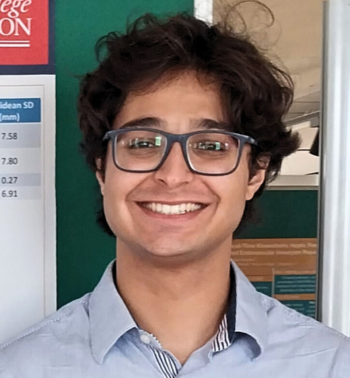
Surgical student and researcher Raghav Khanna, lead author of a journal article on surgery for interplanetary space missions, explains why the digital technologies being developed for long-distance remote procedures can benefit patient care closer to home.
How did the idea for the article come about?
The article itself not an isolated piece of work - it is the continuation of a cutting-edge demonstration led by Prof Prokar Dasgupta OBE HonFREng during the European Robotic Urology Symposium (ERUS) 2025, where 5G and cloud computing techniques were used to telemanipulate 3D prostate models with minimal latency.
This served as proof-of-concept for physician led tele-mentoring onboard the International Space Station (ISS) and, more broadly, in space-based environments. Building on this work, our article examines previous progress in space surgery, identifies clinical, technical and training challenges and defines a broad framework for implementing surgical capability in space, with emphasis on the deployment of robotic systems.
What were the main findings?
Based on population statistics and astronaut physiology, there is a real risk of a surgical event happening during long duration flight, such as a mission to Mars. Coupled with the impossibility of a quick evacuation to Earth, surgical capabilities should be a mission critical feature.
Based on simulator studies performed in zero-gravity parabolic flights and limited animal studies on board the ISS, performing surgery in microgravity is not more challenging than performing surgery on earth, provided two key conditions are satisfied: the operator, patient and instruments are restrained relative to each other; and a suitable containment strategy is used to prevent contamination of the habitable environment by fluids, debris and gases. Robotic surgery is uniquely suited to this setting as it allows for an additional layer of AI assistance to be included. This is particularly relevant given astronauts onboard will likely not have formal surgical training.
The whole ecosystem comes together optimising three pillars: the device, which is compact, multi-functional and robust; the AI system, which can adapt based on updated parameters from Earth and situation and astronaut specific data; and the crew, who must be trained to operate the system, provide basic surgical and anaesthetic/medical care, and follow protocols around mission go/no-go thresholds and resource use.
How could surgery in space research and digital health advancements benefit patient care on Earth?
I see the greatest advantages coming out of advances to telesurgery/digital health and post-operative care. Efforts to reduce latency in communication with spacecraft and the use of AI tools to deliver personalised intra-operative and post-operative guidance could translate into safer remote surgery, tele-mentoring and specialist support for patients in rural, military or disaster settings.
Adjunct technologies such as cloud and edge computing could also allow AI models to be trained, updated and adapted locally for specific surgical events, improving decision support when expert clinicians are not physically present. With regards to post-operative care, one of the key aims for surgical care in space should also be ensuring that the astronaut can recover to full function and resume their duties.
This need will drive the development of smart healing technologies, haemostatic materials, advanced wound closure systems and regenerative biomaterials. These innovations could directly improve wound healing, infection prevention and recovery for patients on Earth.
How do you see the future of surgery in space developing?
Space has again become the next frontier, and our goals are more ambitious, a permanent lunar presence and trips to Mars that will take us beyond the convenience of low Earth orbit. Surgery and advanced medical care in space have not yet been practically implemented because urgent evacuation from the ISS has remained possible as demonstrated by the first medical evacuation from the ISS in January this year.
Future missions may not have this safety net, and surgery in space will be eventually recognised as a critical capability. Given this, I expect to see more research, innovation and protocols being developed. Early steps are already visible, including the experimental deployment of Virtual Incision’s single-arm MIRA robot on the ISS. Over time, this will likely progress towards compact robotic platforms, AI-assisted guidance, tele-mentoring where delays won’t cause a problem, and autonomous support.
Raghav Khanna is a 4th year MBBS medical student at Guy's King's and St Thomas' Medical School, and Researcher in Surgical Robotics, Department of Surgical and Interventional Engineering, at the King’s College London School of Biomedical Engineering and Imaging Sciences.
Learn more about King’s Health Partners Academic Surgery here.